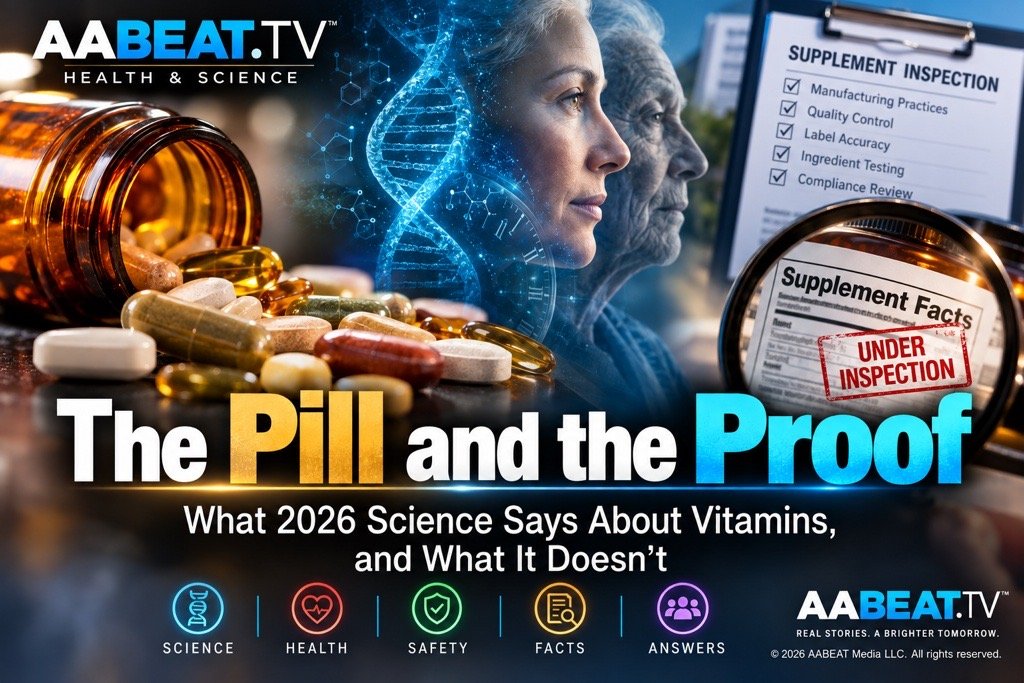
Roughly half of American adults take some kind of dietary supplement. Yet most of us rarely stop to ask two separate questions: does it work, and is what's inside the bottle actually what the label says?
In 2026, researchers made intriguing progress on the first question. At the same time, federal inspection data raised uncomfortable questions about the second. Together, they tell a more complicated story about vitamins than either advocates or skeptics sometimes suggest.
A two-year experiment on biological-aging markers
One of the most interesting vitamin studies of 2026 isn't really about preventing a particular disease. It's about biological aging. Researchers at Mass General Brigham, drawing on the large randomized COSMOS trial, studied whether taking a daily multivitamin was associated with changes in biological-aging markers.

They analyzed blood samples from 958 older adults, whose average age was about 70, using five different epigenetic aging measures. Epigenetic clocks estimate aspects of biological age by examining patterns of DNA methylation, chemical modifications to DNA that tend to change as people grow older.
After two years, participants assigned to a daily multivitamin showed slower biological aging across the five measures, with statistically significant effects on two mortality-predictive epigenetic clocks. Researchers estimated the overall difference at roughly four months of biological aging over two years. The effects also appeared stronger among participants whose biological age was already running ahead of their chronological age.
That is interesting. But it is not a fountain of youth. A change in an epigenetic clock does not automatically mean someone will live four months longer, avoid disease, remain independent longer or gain four additional months of healthy life. These are biomarkers, and researchers still need to determine how changes in them translate into meaningful long-term health outcomes.
The finding nevertheless adds another piece to the broader COSMOS research program. Earlier analyses involving more than 5,000 participants found benefits from daily multivitamin supplementation for global cognition and episodic memory, with researchers estimating the magnitude as roughly equivalent to slowing cognitive aging by about two years. Different analyses within COSMOS are therefore pointing in an intriguing direction, though that is not the same thing as independent replication by unrelated research groups.
There is another detail worth knowing: the investigators disclosed relationships including research support involving supplement companies, and industry partners supplied study products. The researchers reported maintaining control over study design, analysis and publication. That does not invalidate the findings, but it does mean readers should know how the research was funded and supplied. Good science discloses. Good readers notice.
The deficiency nobody planned for
Another vitamin story is emerging from one of the biggest medical trends of the decade: GLP-1 medications. Drugs such as semaglutide and tirzepatide can substantially reduce appetite and food intake, which raises an important nutritional question: when people eat significantly less food, are they also getting enough essential nutrients?
A large retrospective analysis examined 461,382 adults prescribed GLP-1 receptor agonists. Researchers found that 12.7% had a newly recorded nutritional deficiency or related complication within six months, and 22.4% within a year. Vitamin D deficiency was among the most commonly identified problems, while deficiencies involving B vitamins and minerals including calcium, selenium and zinc were also reported.
Those numbers deserve attention, but they require context. This was an observational analysis based largely on medical records and diagnostic coding, not a randomized trial proving that GLP-1 medications caused those deficiencies. Most participants also had type 2 diabetes, and researchers did not systematically perform biochemical nutrient testing on every participant. In other words, the study identifies an important association and a reason to investigate further, not proof of cause and effect.
Researchers are now doing exactly that. A randomized clinical trial is testing whether daily multivitamin supplementation can help maintain levels of nutrients including vitamin B12, vitamin D and iron among people using GLP-1 medications. The results are not yet available, so whether routine multivitamin supplementation should eventually become part of GLP-1 care remains an open question. That distinction matters.
Where the evidence stops
Scientific credibility isn't built only by reporting positive findings. Sometimes the most useful result is that something didn't work.
In a 2026 randomized, double-blind clinical trial involving adults newly diagnosed with COVID-19, researchers tested vitamin D3 against placebo. Vitamin D supplementation did not significantly reduce the study's primary healthcare-utilization outcome or its prespecified COVID-related outcomes. There were signals in some secondary analyses that researchers said warranted additional investigation, but the primary conclusion remained unchanged: vitamin D did not produce the hoped-for benefit in the trial's main outcomes. The honest version of the vitamin story has to include the nulls.
What these studies do, and don't, tell us
Taken together, these studies do not mean everyone should start taking a multivitamin. A biomarker of aging is not the same as living longer. An observational association is not proof that GLP-1 medications cause nutrient deficiencies. And a multivitamin cannot substitute for diagnosing and treating a specific nutritional deficiency or medical condition.
The evidence around supplementation is becoming more interesting, but it remains highly dependent on the population being studied, the supplement being tested, the dose, the outcome being measured and the health of the individual taking it. There is also another question that clinical trials often have to assume has already been answered: what's actually inside the capsule?
The part you can't see on the label
Nearly every supplement study begins with an assumption consumers make every morning: that the product contains what it claims and was manufactured under appropriate quality controls. Recent federal inspection data suggest that assumption deserves scrutiny.
Through a public-records request, ConsumerLab obtained FDA inspection results involving approximately 800 dietary-supplement manufacturing facilities during fiscal year 2025. According to its analysis, 49.1% received FDA Form 483 observations identifying potential problems related to current Good Manufacturing Practices, or cGMPs.
That number sounds alarming, but it needs to be interpreted correctly. It does not mean that 49.1% of supplements on store shelves failed laboratory testing. And an FDA Form 483 does not itself represent the agency's final legal determination that a company violated federal law; it records conditions inspectors observed that may constitute violations and require attention.
Still, the findings raise an important question about consistency across a massive supplement industry. The FDA cannot inspect every manufacturing facility every year. Consumers therefore face a strange contradiction: the science evaluating supplements is becoming increasingly sophisticated, with randomized trials, biological-aging measurements, cognitive testing and large-scale health-data analysis. But the usefulness of that science ultimately depends on something much more basic: the integrity of the product itself.
The pill and the proof
The supplement conversation has often been framed as a simple argument: vitamins work, or vitamins don't work. The evidence suggests the better question is more specific. Which supplement? For whom? At what dose? For what outcome? And supported by what evidence? Then comes the second half of the equation: can you trust the product itself?
The science of supplements is increasingly asking two different questions: does the pill work, and can you prove what's in the pill? In 2026, researchers are getting better at answering the first. The second may ultimately matter just as much. Because when you take something every morning for your health, there is one question worth sitting with: how much do you actually know about where it came from?
This article is for informational and educational purposes and is not medical advice. Decisions about supplements, nutrient deficiencies or prescription medications should be discussed with an appropriate healthcare professional.